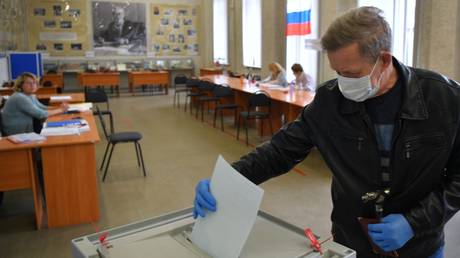
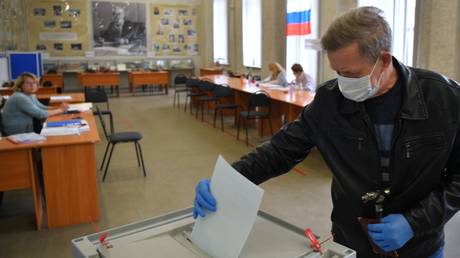
Sitting governors backed by President Putin’s United Russia party have received the majority of votes in weekend elections across the country. There were gains for allies of Alexey Navalny on two Siberian city councils.
The ‘united voting day’ – an event that encompassed gubernatorial, legislative and municipal elections in 41 Russian federal subjects – has seen all sitting and acting regional heads securing victories over their competitors in the first round, with varying degrees of decisiveness.
Even in the Siberian Irkutsk Oblast, which, according to some forecasts, could have had a run-off election, acting regional head Igor Kobzev managed to snatch a victory in the first round by gaining more than 60 percent of the vote. His result was one of the lowest compared to other governors elected on Sunday, though.
Another tighter race was seen in Smolensk, on the border with Belarus, where governor Alexei Ostrovsky had to make do with 58% of the vote. Meanwhile, in separate borderland, Crimea, the incumbent in Sevastopol, Mikhail Razvozhaev, was returned with whopping 85%.
A total of 18 Russian regions, from Kamchatka in the Far East to Leningrad Oblast in the west, chose their leaders in a direct vote, while two more governors were selected by regional parliaments. In all, over 9,000 elections of various types were held in 83 constituent entities of
The highest turnout for a governor race was in the Jewish Autonomous Region, at 70.51%, where the winner cited the ongoing protests in neighboring Khabarovsk as the reason he easily won the contest, with 82% of the vote. “People saw this madness, they don’t want the same here,” Rostislav Goldstein told reporters.
United Russia – the nation’s biggest party – secured a majority in 11 regional parliaments and in legislative assemblies in dozens of cities. However, it lost to the far-right Rodina (Motherland) party in the city council elections in the central Russian city of Tambov and lost its majority in the legislative assemblies in the Siberian cities of Novosibirsk and Tomsk.
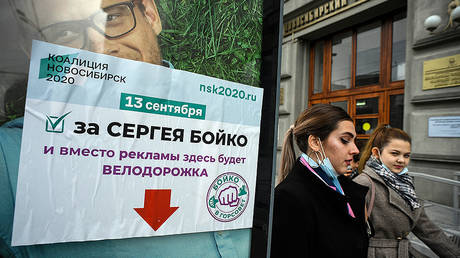
In Tomsk – the last city that opposition figure Navalny visited before being admitted to a hospital following his alleged poisoning in August – two of his allies grabbed city council seats, beating United Russia candidates in their respective constituencies. In Novosibirsk another Navalny ally, Sergey Boyko, managed to snatch a victory in city council elections from his opponent Communist Renat Suleymanov in a tight race.
Meanwhile, Khabarovsk itself routinely re-elected local and municipal heads. The Far Eastern region has seen protests, for two months now, over the arrest of its ex-governor, Sergey Furgal, who is accused of ordering three murders. Yet, according to the acting regional head, Mikhail Degtyarev, the regional elections went “peacefully” and without any “major violations.”
The Russian Central Election Committee (CEC) also said it did not see any major violations during the elections. Neither did the police or the President’s Human Rights Council. However, the election monitoring association Golos (which in the past has received funding from the US and EU) reported “thousands” of irregularities. Police confirmed they did receive a significant number of complaints about suspected “irregularities” but said many of them were “fake.”
The head of the CEC, Ella Pamfilova said the number of violations “were fewer than ever before.” She also accused some of the 177,000 observers of “unprecedented agreesion and rudeness.”
It is the second time that voting in Russia was held over three days – from Friday to Sunday. Officials say the move was taken to avoid overcrowding and protect voters from Covid-19 since Russia is still fighting the epidemic. However, some opposition members have expressed fears that it will make electoral fraud easier. More than one million people have contracted the virus across Russia and 18,400 have died from it.
Think your friends would be interested? Share this story!