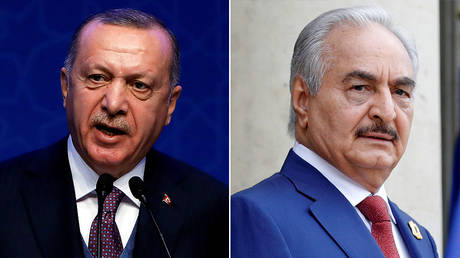
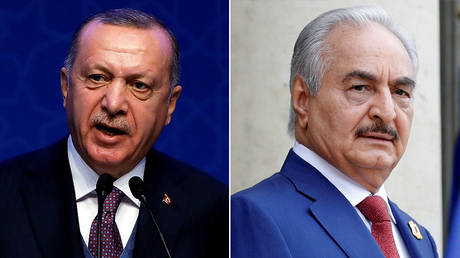
Just days after Turkey vowed “to teach a lesson” to Libya’s strongman General Haftar, Greece – still at odds with Ankara – told him that it could send in some “forces,” tasked with observing a truce and “removal of mercenaries.”
Nikos Dendias, Greece’s Foreign Minister, had “a long conversation” with General Khalifa Haftar, who paid a low-key visit to Athens ahead of a Libya peace conference in Berlin. “We want a ceasefire, the removal of mercenaries and the cancellation of illegal agreements,” Dendias said without elaborating.
The chief diplomat told Haftar, who leads the Libyan National Army (LNA), that Greece was ready to help “with [deploying] forces” that would monitor the ceasefire with the rival Tripoli-based Government of National Accord (GNA).
“All of this is a contribution to the future of the Libyan people. We want it to be a modern democratic country,” Dendias proclaimed.
Υποδέχθηκα πριν λίγο στην Αθήνα τον επικεφαλής του Λιβυκού Εθνικού Στρατού (LNA), Στρατάρχη Khalifa Haftar. pic.twitter.com/nm6ZguPATy
Ankara already sent troops to support the internationally-recognized Tripoli government. Upping the ante, President Recep Tayyip Erdogan has vowed to teach “putschist” Haftar a “lesson” if he doesn’t hold up his offensive against the GNA.
At this stage, both Libyan rivals are sticking to a ceasefire jointly brokered by Turkey and Russia, although they continue to blame each other for violating its terms.Although carefully worded and evasive, the Greek minister’s remarks may add some geopolitical flavor to the Libyan conflict and beyond.
Turkey has a number of territorial disputes with its NATO neighbor Greece, and both countries consistently engage in close-call encounters both at sea and in the air, not to mention historic grievances over Cyprus and other issues.
Greece has been remarkably pro-active on the diplomatic front, threatening that it will veto any European peace deal on Libya unless a Turkey-GNA agreement on maritime borders is annulled.
Athens maintains that the deal, which sets out oil and gas exploration areas in the Mediterranean between Libya and Turkey, is “unacceptable and illegal” because it ignores Greece’s own claims in the area, as Prime Minister Kyriakos Mitsotakis put it.